Bust a Move: An Interview with author Peter Relic on Delicious Vinyl
Submitted by Samuel Lamontagne on August 4, 2026 - 12:00am
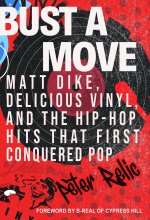
In 1987, Mike Ross and Matt Dike founded Delicious Vinyl, an independent label rooted in Los Angeles’ early 1980s hip-hop and club scenes. Within a year, it crossed into the pop mainstream, scoring major hits with Tone Loc and Young MC—“Wild Thing” and “Bust a Move”—and securing a distribution deal with Chris Blackwell’s legendary Island Records. But the label’s story runs deeper than its chart success. Alongside artists like Mellow Man Ace, Def Jef, Body and Soul, and The Pharcyde, Delicious Vinyl also explored sounds beyond hip-hop, from the acid jazz of The Brand New Heavies to the dancehall-inflected Born Jamericans and the alternative rock of Masters of Reality.
Delicious Vinyl’s impact on Los Angeles’ musical landscape is hard to overstate. It reminds us that L.A. hip-hop history has always been more diverse than the gangsta rap mythology it is too often reduced to. In the late 1980s, Delicious Vinyl helped redefine what pop music could sound and look like from a hip-hop standpoint—and also where it could come from. Despite its large impact on not just LA hip-hop or hip-hop as a whole, but on American popular culture, the legacy of the label remains surprisingly overlooked. This makes Peter Relic’s book Bust a Move all the more necessary.
Published by Kensington, Bust a Move reconstructs the label’s history in detail, tracing the social origins of its founders and artists while mapping the creative networks that shaped Los Angeles music in the 1980s and 1990s. Moving between the label’s evolution, the community that sustained it, and the industry forces it navigated, the book brings together human stories, creative networks, and insider accounts—touching on figures like Jean-Michel Basquiat along the way. It is a richly researched, generous work, and a welcome addition to the study of Los Angeles hip-hop.
In July 2026, I met Peter Relic in Los Angeles, where he was promoting the book at Delicious Pizza, Mike Ross’ restaurant, opened in 2015 with his brother Rick, which in its own way carries forward the label’s legacy. In the weeks that followed, we continued our conversation over email.
-Before ever writing the book, what was your connection to Delicious Vinyl? Did you used to listen to their releases?
My first glimpse of Delicious Vinyl was when I saw the Tone Loc "Wild Thing" video on MTV in October, 1988. I was a senior in high school, chilling on the shag carpeting in the sunken living room at the back of my parents' house in Charlotte, NC. There was Tone on TV, wearing a leather jacket and a Delicious Vinyl t-shirt, surrounded by cool chicks, doing the wop.
I sat up wide-eyed and took notice, clocking that this was a spoof of "Addicted to Love" by Robert Palmer. Tone Loc's video, directed by Tamra Davis, took something soulless and turned into something fresh, funny, and fun. It was a different spin on authentic hip-hop, something I was obsessed with as a kid.
From that point on, I bought what I could when I saw the Delicious Vinyl logo. A big one was the first Def Jef album, Just a Poet with Soul (1989), a true classic album of its era, with its combination of party raps with pro-Black politics and beats you could dance to. A high point in the culture.
-You've had a long career as a music journalist, covering different artists, why did you choose to write a book on Delicious Vinyl?
As the historic record around hip-hop began to coalesce, the story of Delicious Vinyl seemed conspicuous by its absence. I knew the label was deeper than its crossover hits.
In 2009, I was living in Los Angeles and knew this was an LA story. So, I approached label co-founder Mike Ross and he was open to the idea, in his welcoming, laid-back way. Mike said he hadn't seen Matt Dike in person since they'd split up the label in 1994. Suddenly I realized there was a mystery to the history.
That mystique deepened when I read Dan LeRoy's masterful 33 1/3 book about Beastie Boys' album Paul's Boutique (Bloomsbury Publishing, 2006), which includes insights from a phone interview Dan did with Matt Dike. I figured, well, I might be able to get Dike on the phone too. What I never guessed was what was going to happen that night after Dike finally picked up the phone.
-Matt Dike is obviously an important part of the story as the co-founder of the label, but he also has a very special place in the book. The book is kind of framed around him. Can you talk more about Matt Dike and how he became so central to the book?
Matt Dike grew up in a strict Jehovah's Witness community in the rural town of Tuxedo Park, New York in the 1960s and seventies. That meant living according to God's will, reading the Bible, and believing the world was about to end. There was room for rebelling if you could wriggle free. I think the fervor that Matt Dike later applied to record collecting was highly religious in its own way. The records he produced were revelations. I wanted to glean their genesis, which meant going back to his childhood.
There are a couple nonfiction books I want to mention. One is Pat Gilbert's epic story of the Clash, Passion is a Fashion (Hachette, 2004), which digs into the childhood of each member of that band in a way that illuminates who they became as young men. It shows why they needed to make the music they did. The other book is Who Does That Bitch Think She Is? (PublicAffairs, 2023) by Craig Seligman, a history of drag in San Francisco in the 1970s, particularly the sensational queen Doris Fish, and how an obsessive form of outsider art, through its brilliance, influenced mainstream culture.
Both books were helpful and inspiring as I considered how to angle the frame for Bust a Move.
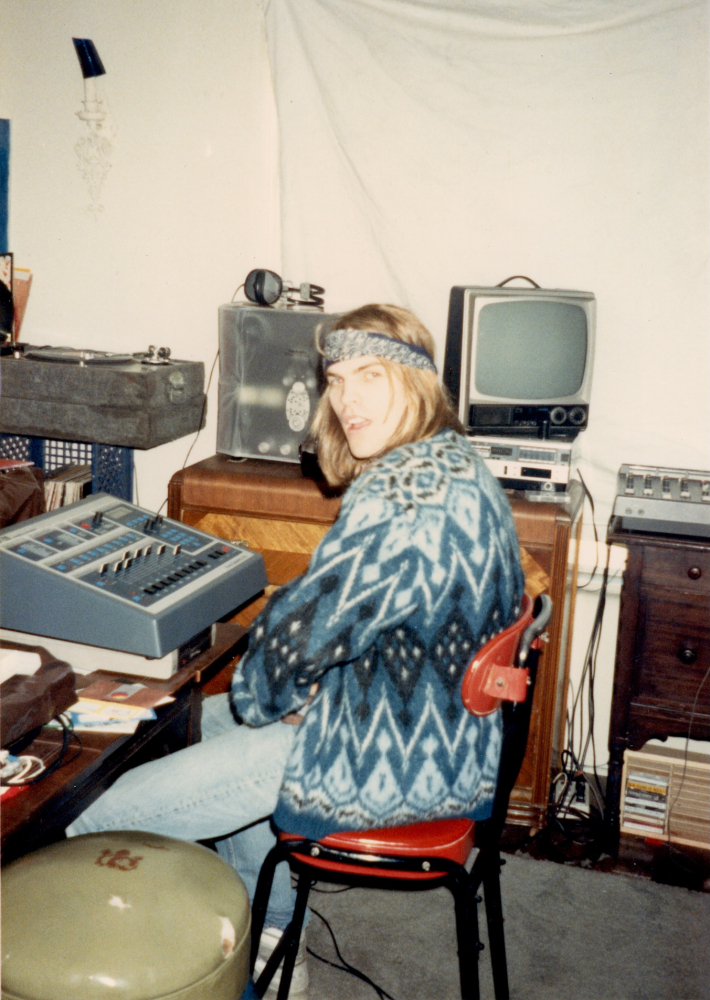
Matt Dike by Mario Caldato
-How did the book come together in terms of research? It seems that interviews were an important part of the research, how did the Delicious Vinyl community support the project?
When I started working on the book, I conducted interviews with Delicious Vinyl artists, producers, engineers, promoters, publicists, friends and family, as well as former night owls who'd gone to Rhythm Lounge and Power Tools, clubs where Matt Dike had DJ'ed before founding Delicious Vinyl. I wrote and wrote for almost five years, but I couldn't stick the landing. The book didn't work. I stashed my early drafts in a box and put it in the closet.
When Matt Dike died in 2018, I realized that I was duty-bound to see the project through. That meant more interviews and going deeper into the story. I spoke with people including Cheryl Dickerson, who had been A&R director of the Black Music Division at MCA in the 1980s, when a young Mike Ross was an intern there. I realized that folks I thought were maybe tangential to the story could actually offer insights that unlocked the whole thing.
-Delicious Vinyl was an essential part of shaping early L.A. hip-hop. In the book you show how the label and the production of the music were steeped in the L.A. hip-hop scene of the 1980s with clubs like Rhythm Lounge and Power Tools. Can you tell a bit about how those clubs were key in the making of Delicious Vinyl?
Thanks for asking this essential question.
Rhythm Lounge was a club led by a Moroccan immigrant and filmmaker named Salomon Emquies. It was held in a slightly seedy venue in Hollywood called Grandia Room, and it's where Matt Dike and Mike Ross first met in 1983. At the time, Mike Ross was a UCLA student and aspiring DJ who'd grown despondent that the clubs in Brentwood were indifferent his desire to spin funk. Mike was astonished to discover this club where Dike was DJing, where all kinds of different people were getting down, together. Matt and Mike recognized that they were kindred spirits right away.
Power Tools, held in the old Park Plaza hotel near MacArthur Park in LA, was the next level: bigger crowds, more ambitious performance art, and the place where recombinant subcultures like skateboarding, punk rock, mod and goth intermingled for the sake of artistic expression and having fun together. It's also the place where Matt Dike met Mario Caldato, who became Delicious Vinyl's in-house engineer, and N'Dea Davenport, who became the singer with the Brand New Heavies. The constellation was taking shape.
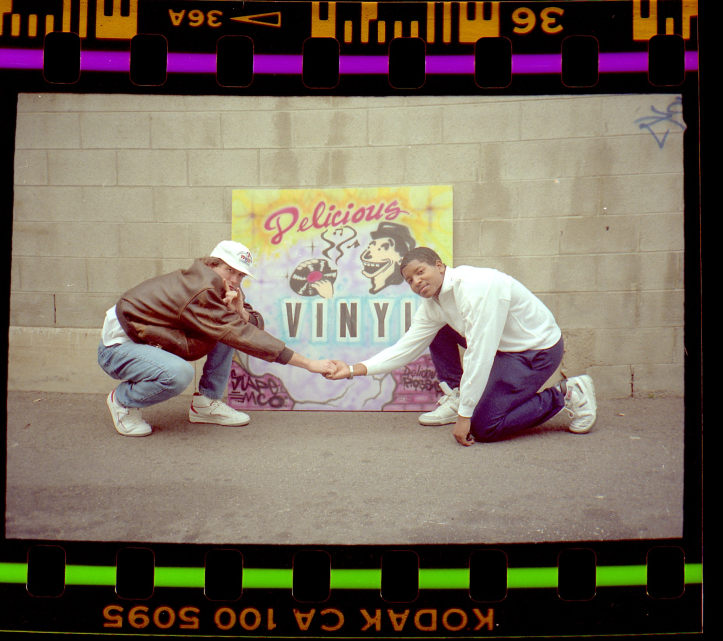
Mike Ross and Young MC in front of DV painting
-While being very important for L.A., something to note about Delicious Vinyl is how deeply connected they were to New York. Can you say more about that connection to NYC?
If you were making rap records, or interested in hip-hop in any way in the 1980s, you looked to New York City, because that's where it originated. In the book, Young MC points out that at the time, if you weren't from NYC, cats said you weren't legit.
It turns out Young MC actually is from New York, he grew up in Hollis, Queens. He came out to LA to study economics at University of Southern California in the fall of 1987. That geographic remove provided just enough room to do things a little differently.
In his song "Bust a Move," Young MC has four sixteen-bar verses and doesn't mention his own name once. The whole narrative is told in the second person. As Young MC points out, being a rapper and not mentioning your own name in your song was a sin!
Delicious Vinyl exploded the idea that real hip-hop had to be made in New York City. Part of what Delicious Vinyl brought to the table was a sense of freedom that feels distinctly Californian. Dike and Ross had been in awe of Def Jam and New York rap's ruling class. Then they eclipsed it. Suddenly the map of rap was redrawn, and a world of possibility opened up.
-Delicious Vinyl's impact both culturally and commercially was tremendous. Yet the importance of the label is a bit disregarded in today's collective memory and how we imagine L.A. hip-hop history. Why do you think that is?
The big hits — "Wild Thing" and "Funky Cold Medina" by Tone Loc, and Young MC's "Bust a Move" — crossed over to the top of the pop charts. Therefore, they're lumped in with other pop wonders of their era, rather than being considered as ground-shifting hip-hop classics. I wanted the book to address that.
The other reason is the rise of gangsta rap, and how synonymous it became with hip-hop in L.A. for a very long time. (You get a glimpse in the book of the concurrent rise of Ruthless Records and N.W.A, whose album Straight Outta Compton came out in January, 1989, right as "Wild Thing" was blitzing MTV.)
Of course, students of L.A. hip-hop history know about underground movements like Project Blowed, and Delicious Vinyl's key homegrown act in the nineties, The Pharcyde, but I think it wasn't until Odd Future arrived that there was a new, undeniable signifier that hip-hop in L.A. has always been stranger than it seems.
-Although I couldn't come to the Grammy Museum event you had, I was able to come to the book signing event at Delicious Pizza. It was great to see so much interest in the book and how alive the Delicious Vinyl community is. What do you think Delicious Vinyl's legacy is in today's cultural landscape? How's the book been received by Delicious Vinyl's community so far?
Thanks for coming out to the publication day event, Sam. One of the really nice things that I couldn't have predicted is how positive people have been about the book. There was a collective joy that you were part of that night at Delicious Pizza that was a manifestation of togetherness. For folks who were part of the scene back then, the book is an occasion to celebrate a unique creative time in their lives that still informs who they are today. Those vibrations connect multiple generations.
Delicious Vinyl wasn't trying to engineer pop hits in a laboratory. These were music freaks trying to make dope beats and funny rhymes and the best songs they could, all in the studio they built in Matt Dike's apartment. That purity of intent is one of the reasons the records have lasted. You feel the love they were made with when they're played today.
Everyone came together. White, Black, Asian, Cuban, Mexican, immigrant, LA native, transplant, straight, queer, stoner, doer, dreamer — a true mix of people looking at each other and being like, "Yo, let's do this!" Collaborative diversity was key. That's a true reflection of the city of Los Angeles, then and now, and of the world we live in. That's Delicious Vinyl's legacy.
"Sounding Board" is intended as a space for scholars to publish thoughts and observations about their current work. These postings are not peer reviewed and do not reflect the opinion of Ethnomusicology Review. We support the expression of controversial opinions, and welcome civil discussion about them. We do not, however, tolerate overt discrimination based on race, sex, gender, sexual orientation, or religion, and reserve the right to remove posts that we feel might offend our readers.
What's New

Bust a Move: Matt Dike, Delicious Vinyl & the Hip-Hop Hits that First Conquered Pop (Kensington Book, 2026) In 1987, Mike Ross and Matt Dike founded Delicious Vinyl, an independent label rooted in Los Angeles’ early 1980s hip-hop and club scenes. Within a...

Hua Wenyi (1941–2022) was one of the most influential Kunqu opera performers of her generation. Born and trained in Shanghai, China, she rose to prominence as a leading dan (refined female-role) performer and later served as the director of the Shanghai Kun Opera...