Exploring the Hua Wenyi Collection on California Revealed
Submitted by Maureen Russell on January 23, 2026 - 6:44pm
"Exploring the Hua Wenyi Collection on California Revealed" by Mei-Chen Chen.
The UCLA Ethnomusicology Archive is honored to celebrate the Kunqu legacy of Hua Wenyi on February 9, 2026. In 2023, the Archive acquired the Hua Wenyi Collection, which includes still images, videos, and documentation that reflect her extraordinary contributions to Kunqu opera, both in the United States and worldwide.

Thanks to the collaboration with California Revealed, a significant portion of this collection has been digitized and made openly accessible. This blog post offers an introduction to selected materials now viewable through California Revealed.
Hua Wenyi: A Master of Kunqu Opera

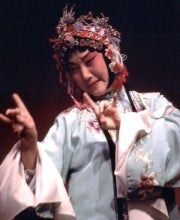
Hua Wen-yi. Collection 2023.06. University of California, Los Angeles, Ethnomusicology Archive. Photo courtesy Yue Xie.
Hua Wenyi (1941–2022) was one of the most influential Kunqu performers of her generation. Born and trained in Shanghai, she rose to prominence as a leading dan (refined female-role) performer and later served as Director of the Shanghai Kun Opera Company.
After relocating to California in 1989, Hua co-founded the Hua Kun Research Institute in Los Angeles alongside Dr. Susan Pertel Jain. Together, they produced performances, workshops, and lectures that brought Kunqu’s aesthetics to diverse audiences and helped cultivate a new generation of practitioners and admirers.
Oral Histories: Collaboration and Artistic Vision
In a two-part oral history interview, Dr. Susan Pertel Jain reflects on her early encounters with Hua Wenyi, the founding of the Hua Kun Research Institute, and their years of creative collaboration.
Hua Wenyi’s first major U.S. performance was presented at the 1990 Los Angeles Festival, where Dr. Jain played a central role in organizing the Kunqu program. The full Kunqu performance from the 1990 Festival is digitized and available through California Revealed.
- The Kunqu Chinese Opera at the 1990 Los Angeles Festival 1
- The Kunqu Chinese Opera at the 1990 Los Angeles Festival 2
- The Kunqu Chinese Opera at the 1990 Los Angeles Festival 3
- The Kunqu Chinese Opera at the 1990 Los Angeles Festival 4
- The Kunqu Chinese Opera at the 1990 Los Angeles Festival 5
- The Kunqu Chinese Opera at the 1990 Los Angeles Festival 6


English & Chinese program of the Kun Chinese Opera, 1990 Los Angeles Festival. Collection 2023.06. University of California, Los Angeles, Ethnomusicology Archive.
Kunqu Across Borders: Taiwan, Europe, and Beyond
Hua Wenyi’s influence extended far beyond the United States. She frequently collaborated with Taiwanese traditional opera communities. One highlight from the collection is a live recording of Hua Wenyi’s Peony Pavilion in Taipei (1992), capturing her presence in dialogue with Taiwanese Kunqu revival movements. Another exceptional video captures Hua Wenyi performing Peony Pavilion with the Dapeng National Opera Troupe of Taiwan in Paris.
In 1991, Hua performed A Stroll in the Garden & An Interrupted Dream (遊園驚夢) at the Festival de Teatro Madrid. Tour footage from Spain captures not only her onstage mastery, but also glimpses of her personality and artistic ethos offstage.
Hua Wenyi’s lifelong dedication to Kunqu was nationally recognized in 1997, when she received the National Heritage Fellowship from the National Endowment for the Arts, the highest honor in the United States for folk and traditional artists. The collection preserves extensive documentation related to this honor, situating the fellowship within the broader arc of her transnational career and cultural legacy.
Avant-Garde Encounters: Peony Pavilion with Peter Sellars and Tan Dun
Hua Wenyi’s collaborations with visionary American theater director Peter Sellars further broadened Kunqu’s influence in contemporary performing arts. The collection includes an audio recording of Sellars’ experimental, boundary-pushing interpretation of Peony Pavilion, featuring Hua Wenyi as Du Liniang, with music composed by Tan Dun.

Hua Wenyi’s script and score used for performing Peony Pavilion. Collection 2023.06. University of California, Los Angeles, Ethnomusicology Archive.
An accompanying oral history interview with Peter Sellars and Dr. Susan Pertel Jain offers insight into their creative process, Hua’s artistic presence, and the lasting impact of their collaboration.

Image captured from the oral history interview with Peter Sellars and Dr. Susan Pertel Jain on April 5th, 2024. Collection 2023.06. University of California, Los Angeles, Ethnomusicology Archive.
Teaching and Community Practice in Southern California
Hua Wenyi played a formative role in nurturing Kunqu practice in the U.S. The collection also documents her coaching and artistic leadership within Southern California’s Kunqu community, such as the 1997 concert at Occidental College, where she performed The Horse Trader's Tale (販馬記全本) at the "Welcoming Spring 1997: Two Evenings of Kun and Beijing Opera," and performed A Banquet for Two (小宴) at the Barclay Theatre in Irvine. These recordings show Hua Wenyi as both performer and mentor, dedicated to strengthening Kunqu opera practice in Southern Celifornia.

Advertisement for the Welcoming Spring 1997 performance on Chinese newspaper. Collection 2023.06. University of California, Los Angeles, Ethnomusicology Archive.
Celebrating the Donation and Her Living Legacy
Please join us on February 9, 2026 in the Recording Studio, Evelyn & Mo Ostin Music Center, UCLA, to celebrate the donation of Hua Wenyi’s personal collection to the UCLA Ethnomusicology Archive, where the recordings, still images, and more will be preserved for future generations. If you are unable to join us in person, (the event is free and open to the public), please watch the Livestream of the event. For more information, check out the event listing on the UCLA Herb Alpert School of Music events calendar. This event is sponsored by the UCLA Ethnomusicology Archive and the UCLA Asia Pacific Center.
"Sounding Board" is intended as a space for scholars to publish thoughts and observations about their current work. These postings are not peer reviewed and do not reflect the opinion of Ethnomusicology Review. We support the expression of controversial opinions, and welcome civil discussion about them. We do not, however, tolerate overt discrimination based on race, sex, gender, sexual orientation, or religion, and reserve the right to remove posts that we feel might offend our readers.
What's New

Bust a Move: Matt Dike, Delicious Vinyl & the Hip-Hop Hits that First Conquered Pop (Kensington Book, 2026) In 1987, Mike Ross and Matt Dike founded Delicious Vinyl, an independent label rooted in Los Angeles’ early 1980s hip-hop and club scenes. Within a...

Hua Wenyi (1941–2022) was one of the most influential Kunqu opera performers of her generation. Born and trained in Shanghai, China, she rose to prominence as a leading dan (refined female-role) performer and later served as the director of the Shanghai Kun Opera...