Music Alive in the Archive: Celebrating the Music and Legacy of Hua Wenyi
Submitted by Maureen Russell on February 20, 2026 - 12:53am
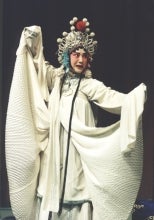
Hua Wenyi (1941–2022) was one of the most influential Kunqu opera performers of her generation. Born and trained in Shanghai, China, she rose to prominence as a leading dan (refined female-role) performer and later served as the director of the Shanghai Kun Opera Company. After relocating to California in 1989, she co-founded the Hua Kun Research Institute in Los Angeles with Susan Pertel Jain, through which they organized performances, workshops, and lectures that introduced Kunqu aesthetics to wider audiences. Recognized nationally for her contributions, Hua Wenyi received the prestigious National Heritage Fellowship from the National Endowment for the Arts in 1997.
Photo courtesy: Yue Xie.
In 2023, her daughter, Jane Xue, generously donated her mother’s California materials to the UCLA Ethnomusicology Archive. With support from California Revealed, the Ethnomusicology Archive was able to digitize the Hua Wenyi Collection and make it available online, open access, as part of California Revealed.
On 9 February 2026, the UCLA Ethnomusicology Archive celebrated the legacy of Hua Wenyi with a roundtable discussion and performances by the Kunqu Opera Society USA and UCLA Kunqu students from the UCLA Music of China Ensemble, directed by Chi Li.

The UCLA Music of China Ensemble performs selections from the Kunqu repertoire. (l-r: Yifan Zhuo, Jinghan Liu, and Chi Li.) Photo by Vinai Supamongkolthaveesuk.

The UCLA Music of China Ensemble performs selections from the Kunqu repertoire. (l-r: Helen Rees, Chutian Shi, Lan Nguyen, and Eleanor Vo.) Photo by Vinai Supamongkolthaveesuk.
For those unfamiliar with the genre, Kunqu opera is the classical opera of China that emerged in the 16th century and remains one of the most enduring classical theatrical traditions in the world. In 2001, it was designated a UNESCO Masterpiece of the Oral and Intangible Heritage of Humanity. Hua Wenyi’s artistry and teaching brought this centuries-old tradition into contemporary cultural life, shaping generations of performers and scholars. Her collaborations with avant-garde American theater director Peter Sellars further expanded Kunqu’s visibility and influence in the United States. As Sellars told the Los Angeles Times on first seeing Hua Wenyi perform, “That was one of the most profound performances of my lifetime. Hua Wenyi has the most powerful eyes of anyone in Chinese opera.”

UCLA Kunqu students (c. Milo Dillon) from the Music of China Ensemble present the aria “Flowers in Full Splendor” from The Palace of Eternal Life. Photo by Vinai Supamongkolthaveesuk.

Members of the Kunqu Opera Society USA honor Hua Wenyi’s legacy through signature excerpts. Christina Jin and Fang Wei perform “The Garden Stroll” from The Peony Pavilion. Photo by Vinai Supamongkolthaveesuk.

Wei Wang performs “The Interrupted Dream” from The Peony Pavilion. Photo by Vinai Supamongkolthaveesuk.

Yule Liu and Yimeng Liu perform “The Little Banquet” from The Palace of Eternal Life. Photo by Vinai Supamongkolthaveesuk.

Jane Xue (Hua Wenyi’s daughter), The Kunqu Society USA, and the UCLA Music of China Ensemble. Photo by Vinai Supamongkolthaveesuk.
Through conversation, performance, and archival presentation, the evening honored Hua Wenyi’s life, her teaching, and her enduring artistic spirit.
Music Alive in the Archive: Celebrating the Music and Legacy of Hua Wenyi, 9 February 2026. Opening: Helen Rees; Family Remarks: Jane Xue; Introducing the Hua Wenyi Collection: Maureen Russell and Mei-Chen Chen; Roundtable: Li-Yung Hou, Ledell Wu, Susan Pertel Jain, Chi Li. Performances by the Kunqu Opera Society USA and UCLA Kunqu students from the UCLA Music of China Ensemble, directed by Chi Li.
The event was co-sponsored by the UCLA Ethnomusicology Archive and the UCLA Asia Pacific Center; With Support from the Kunqu Opera Society USA and the UCLA Music of China Ensemble.
Photos © Regents of the University of California, All Right Reserved.
"Sounding Board" is intended as a space for scholars to publish thoughts and observations about their current work. These postings are not peer reviewed and do not reflect the opinion of Ethnomusicology Review. We support the expression of controversial opinions, and welcome civil discussion about them. We do not, however, tolerate overt discrimination based on race, sex, gender, sexual orientation, or religion, and reserve the right to remove posts that we feel might offend our readers.
What's New

Bust a Move: Matt Dike, Delicious Vinyl & the Hip-Hop Hits that First Conquered Pop (Kensington Book, 2026) In 1987, Mike Ross and Matt Dike founded Delicious Vinyl, an independent label rooted in Los Angeles’ early 1980s hip-hop and club scenes. Within a...

Hua Wenyi (1941–2022) was one of the most influential Kunqu opera performers of her generation. Born and trained in Shanghai, China, she rose to prominence as a leading dan (refined female-role) performer and later served as the director of the Shanghai Kun Opera...